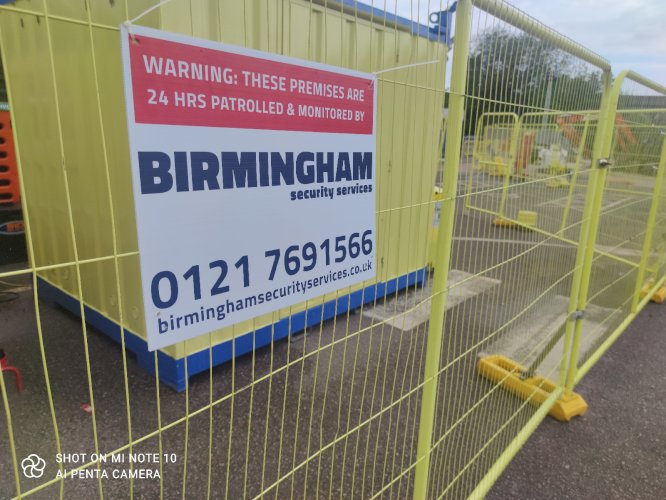
Construction site crime is a problem across the UK, but Birmingham faces unique challenges that make its building projects especially vulnerable. As one of the fastest-growing cities in the country, the combination of regeneration, population density, and organised criminal activity creates a high-risk environment for contractors and developers.
Understanding these local risk factors is essential for creating an effective construction site security strategy in Birmingham.
With over 1.1 million residents, Birmingham is the UK’s second-largest city. High population density brings more foot traffic near building sites, increasing the likelihood of opportunistic theft, particularly for sites close to residential areas.
Birmingham is at the centre of the UK’s motorway and rail network, with direct access to the M6, M5, M42, and major A-roads. These excellent connections benefit the city’s economy, but they also make it easier for criminals to transport stolen goods out of the area quickly, reducing the chance of recovery.
Ongoing regeneration projects, commercial builds, and housing developments create constant demand for building supplies and heavy equipment. This demand fuels a thriving black market in Birmingham for stolen tools, metals, and plant machinery.
According to West Midlands Police, organised crime groups are increasingly targeting Birmingham construction sites for high-value thefts. Plant machinery, metals, and specialist equipment can be stolen and shipped abroad within 48 hours, making fast response and prevention critical.
Birmingham’s mix of inner-city and suburban developments creates varied risks:
Criminals exploit predictable patterns:
Recent crime statistics show that construction site theft in Birmingham has risen by more than 20% in the past two years, with plant theft alone making up a significant share of reported incidents.
The combination of high-value assets, population pressure, and organised crime makes Birmingham one of the UK’s most challenging environments for construction security. To protect assets, minimise risks, and keep projects on schedule, site managers need a layered security strategy including:
Investing in professional construction site security in Birmingham not only protects your site but also reduces insurance costs, prevents project delays, and builds confidence among stakeholders.
Keeping your site secure is vital for protecting staff, equipment and project timelines. These FAQs explain how our security services support construction sites of all sizes across Birmingham.
This guide explains our services, processes and the expertise behind our team so you can make confident and informed decisions. If you have any questions that are not answered here, our support team is available around the clock. You can contact us by email or through our online form. Your security matters to us and we are here to help at every stage.
In the UK, securing a construction site is a legal duty mandated by several key pieces of legislation. Compliance requires proactive measures to prevent unauthorized access and criminal activity.
The primary legal requirements stem from:
The Health and Safety at Work etc. Act 1974: This fundamental law obliges employers to ensure, so far as is reasonably practicable, the health and safety of their employees and the public. This duty explicitly includes implementing security measures to protect sites from unauthorized entry and theft, which could lead to accidents or injuries.
The Construction (Design and Management) Regulations 2015 (CDM 2015): These regulations mandate a coordinated approach to security. Clients, principal designers, and principal contractors must collaborate to identify, assess, and manage risks throughout a project. This joint responsibility includes planning for and mitigating security risks, such as vandalism or theft, from the pre-construction phase onwards.
Urban construction sites present distinct security obstacles not commonly found in rural settings. These sites are typically at higher risk for theft, vandalism, and unauthorized entry due to their location and surroundings.
Key challenges include:
The number of guards required depends on several key factors, including site size, number of access points, operating hours, and overall risk level.
For example:
Professional providers will carry out a detailed site survey and risk assessment before recommending staffing levels. The goal is to strike the right balance between effective protection and cost efficiency, ensuring your construction site security in Birmingham is neither under-resourced nor unnecessarily expensive.
In many cases, construction site security in Birmingham can be arranged quickly. Standard deployments can often be set up within a few days, while urgent requirements may be covered within hours, depending on availability.
Deployment timelines depend on factors such as:
For larger or higher-risk sites, more preparation may be needed to ensure the right level of protection. Engaging with a provider early allows for smoother mobilisation and a more effective security setup.
We provide a full range of advanced security technology suitable for both large and compact construction sites. Our systems include:
These solutions help safeguard vulnerable areas while providing full site visibility.
Yes, many businesses in Birmingham use dual-role security officers who combine guarding responsibilities with front-of-house duties.
These may include:
This approach works particularly well in office environments, where it creates a professional first impression while maintaining strong site security in Birmingham.
However, security responsibilities must always remain the priority. Guards must be properly trained, fully licensed, and ready to respond to incidents at all times.
Manned guarding provides a continuous on-site presence, with security officers stationed at your premises throughout their shift. This ensures immediate response to incidents and constant monitoring, which is essential for high-risk environments such as construction site security in Birmingham.
Mobile patrol services, on the other hand, involve security teams visiting multiple locations at scheduled or random intervals. These visits are typically short and focus on inspections rather than continuous supervision.
Many businesses choose a combined approach. For example, static guards may protect key access points or high-value areas, while mobile patrols cover larger perimeters or lower-risk zones. While manned guarding offers faster response and stronger deterrence, mobile patrols provide a more cost-effective option for wider coverage across multiple sites.
Manned guarding is not limited to large organisations. It can be scaled to suit small businesses, including offices, retail units, and workshops.
For smaller sites requiring site security in Birmingham, businesses often choose flexible options such as:
A professional risk assessment will determine whether full-time guarding, part-time cover, or a combination of manned security and technology is the most cost-effective solution. In many cases, insurers view manned guarding positively, which can be beneficial for smaller businesses with limited tolerance for financial loss.